
LEARN MORE
WHAT
IS A KETTLEBELL?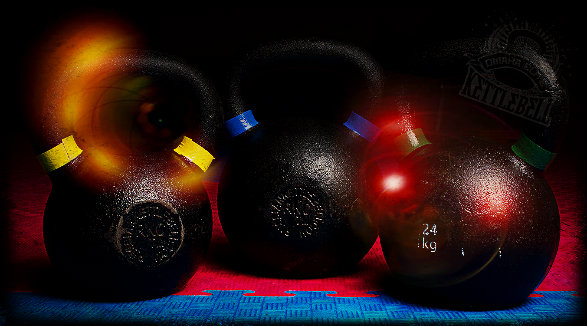
A
kettlebell is a cast iron weight in the shape of a cannon ball with a
handle resembling that of a tea kettle (hence the term ‘kettle’bell).
Kettlebells can be used for both grinds, such as presses, squats, etc.,
and ballistic lifts, such as the swing, clean, jerk and snatch. Their
versatility as a tool for both strength and conditioning has lead to
their popularity around the world.
Kettlebells originate from Russia, where they have a long history. The Russian word for kettlebell, girya, first appeared in a Russian dictionary in 1704 (Cherkikh, 1994). They have long been popular in Russia, and were also popular among American strong men of old.
The recent resurgence in popularity of kettlebells as a training tool is thanks largely to the efforts of Pavel Tsatsouline, a former Soviet Special Forces instructor who immigrated to the U.S. in the 1990s. In 1998 at the urging of his friend, the legendary powerlifting coach Marty Gallagher, Pavel wrote the article “Vodka, Pickle Juice, Kettlebell Lifting, and Other Russian Pastimes” for MILO, a strength journal popular among people who lift rocks, bend steel, and do an assortment of other crazy things. The response he received for this article was positive beyond what he expected. In 2001, Pavel founded the RKC, the first ever kettlebell instructor course in America. Ten years later, the RKC remains the gold standard in kettlebell instruction and attracts a wide variety of people to its ranks, from athletes to everyday hard men and women, and the popularity of kettlebells continues to grow.
WHY KETTLEBELLS?
Are Kettlebells Right for Me?
Kettlebell training can be scaled to just about anyone, from children to athletes to the average Joe/Jane to the elderly. We have successfully trained students young as nine years old, and when I received my certification in Orlando in October 2010, there was a man in my group who was 73 years old! With very few exceptions, almost all kettlebell exercises can be modified and made appropriate for just about anyone. Kettlebell training is tough no matter what, but it is not an elitist activity. Whether your goal is to become a human dynamo with infinite strength and conditioning or just to stay active without spending hours at a gym, kettlebell training can get you to where you want to go and faster than you ever thought possible.Strength.
“Can kettlebells make me strong?” Without a doubt! The RKC is referred to as a School of Strength because that is our primary focus – pure, raw strength. Strong men and women of all types throughout the ages have trained with kettlebells to great effect. Here are some examples: Soviet Olympic Weightlifting legends Yury Vlasov, Leonid Zhabotinsky, and Vasiliy Alexeyev were all proponents of kettlebell training.
Old school Russian strongman Pyotr Kryloff, known for his ability to cross himself in the Russian Orthodox style and juggle three kettlebells at once (as well as being able to break rocks with his fists, make ties and bracelets out of strips of iron, etc.) was widely referred to as “The King of Kettlebells”. German-American strength training legend Sig Klein, famous for feats of strength such as pressing pairs of 100-lb dumbbells at a body weight of 150, was an early 20th century proponent of kettlebell training.
One-time Master RKC Kenneth Jay has strict-pressed two 70-lb kettlebells in one hand, a feat he accomplished solely through his diligent use of kettlebell training.
Even more remarkable about kettlebells is their carry-over effect into other forms of training. Senior RKC Peter Lakatos has deadlifted over 430 lbs without a lick of support gear and without ever touching a barbell, all thanks to heavy kettlebell swings and squats.
RKC Team Leader Mark Toomey has squatted a barbell loaded up to 315 lbs for five solid butt-to-ground reps and similarly thanks kettlebell swings and squats at nowhere near that weight for his accomplishment. Powerlifting world record setter and the man with the highest overall powerlifting total in history, Donnie Thompson, RKC, put off deadlifting for nearly a whole year, choosing to practice kettlebell lifting instead and saw his already immense deadlift shoot from 766 lbs to 832 lbs.
Justin Qualler, RKC, worked most of his way up to a one-arm chin up simply by working the negative portion of his heavy military presses as hard as he could. <> Can you hope for results like these simply by choosing kettlebell training? Almost certainly. As long as your practice is consistent, your focus is sharp, and your instruction is good, kettlebells are a great tool for scaffolding just about any of your strength goals.
Conditioning.
Kettlebells are unrivaled by any other piece of fitness equipment in terms of their ability to give you superhuman conditioning – and in record time. Elite Russian army units test the high-rep kettlebell snatch – the Czar of Kettlebell lifts – instead of pushups as a measure of their units’ level of physical conditioning. Kettlebell ballistic lifts like the swing, snatch, and jerk are renowned for their ability to take your conditioning level from mere mortal to god-like.
In a study conducted by the American Council on Exercise (ACE), the benefits of the kettlebell snatch were tested on a group of 10 individuals ranging in age from 29 to 46, and the results were astonishing. “[T]hey were burning at least 20.2 calories per minute, which is off the charts. That’s equivalent to running a 6-minute mile pace. The only other thing I could find that burns that many calories is cross-country skiing up hill at a fast pace,” says John Porcari, PhD and member of the research team that conducted the experiment. Upon his first dance with kettlebell swings, cleans, and snatches, Michael Castrogiovanni , a well-conditioned wrestler, reported that his heart rate rocketed to 221 beats per minute – after only seven minutes. Russian Professor Arkady Vorobyev conducted an experiment in which he found that performing just 10 double kettlebell cleans with 72 lb kettlebells significantly elevated the heart rates of even experienced weight lifters. Even after 10 minutes of rest, they still did not come back down.
Fat Loss
As
with brute strength and conditioning, the kettlebell stands head and
shoulders above all other pieces of fitness equipment for its ability
to hack fat from your frame. Want proof? Look no further than the
stories of a few notable figures. Master RKC David Whitley knocked 24
lbs off of his body in 17 weeks thanks to kettlebells. Tracy Reifkind,
RKC, slashed over 100 lbs of fat from her body in less than a year by
simply practicing kettlebell swings three days a week for 20-minutes.
That's a mere 4-hours of training per month! 
For an example closer to home, local HKC Kelly Rushlow has bidden farewell to 120 excess pounds, the vast majority of which comes as a result of her kettlebell practice.
“Omaha Elite Kettlebell has transformed my fat, tired, and aching 40 year old body into an athletic body I haven’t known in 20 years.” -David “ “I became stronger in all aspects, and I lost body fat at an incredible rate.” – AllisonThe list could go on and on, as these results are not atypical. It goes without saying that these comrades cleaned up their act when it came to their eating habits and maintained a laser-sharp focus on their practice sessions to achieve the results that they did, and the same applies to you. To quote the aforementioned Master RKC David Whitely “You can’t out-snatch a donut.” Don’t kid yourself – find a reputable source of nutrition information, make the necessary adjustments to your diet, and start swinging. Your body will thank you.